
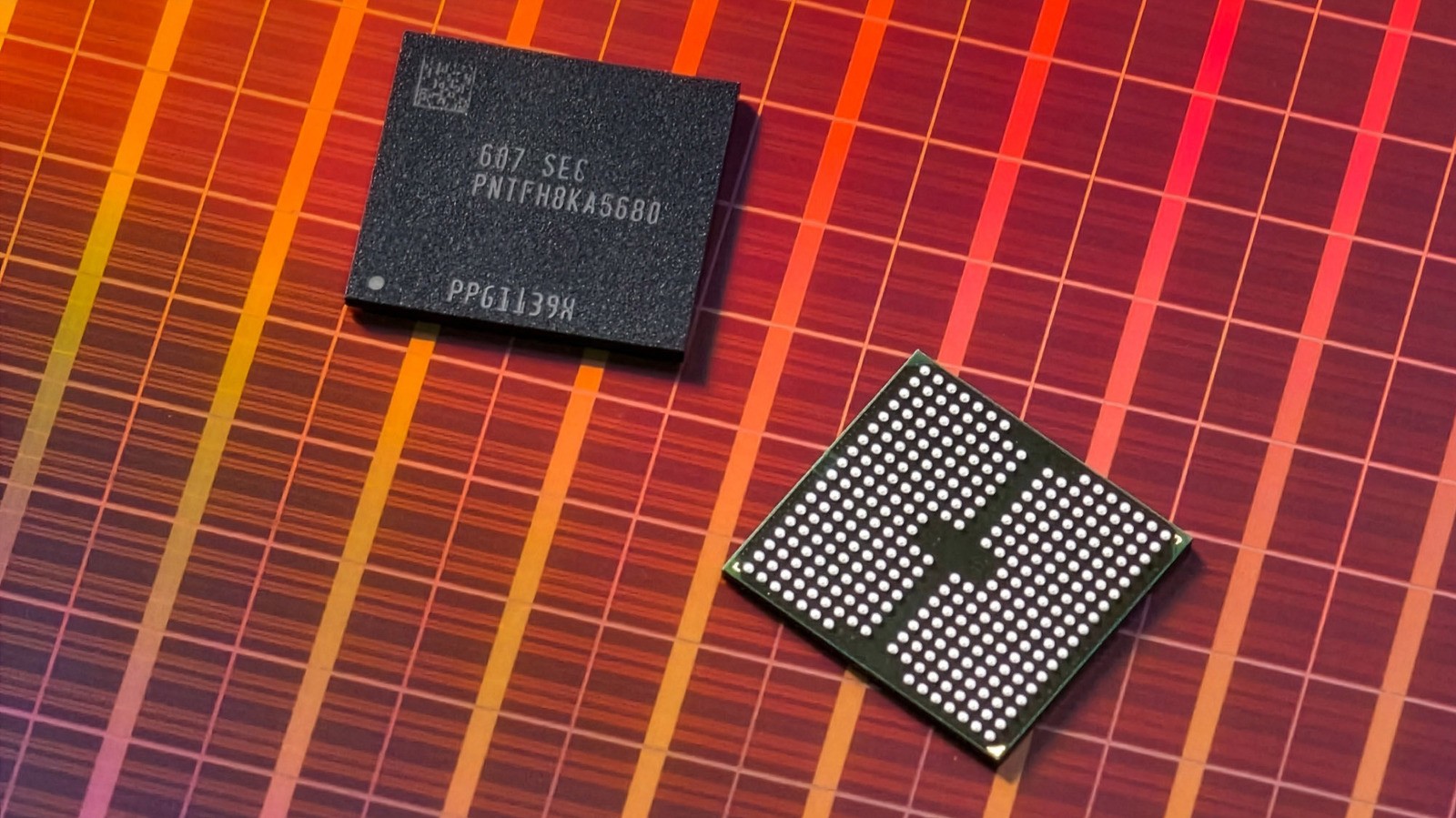
Samsung’s latest memory announcements, made at the Future of Memory and Storage show in Santa Clara, bring significant improvements for AI infrastructure but do little to help the average consumer find reasonably priced memory upgrades for their PCs. The company unveiled a new generation of 3D memory designed for data centers and high-end AI hardware.
Samsung’s new zHBM architecture stacks high-bandwidth memory directly over AI accelerators. This vertical arrangement, instead of the traditional side-by-side layout, boosts performance by up to eight times. The memory also uses next-gen wafer bonding to achieve over 10 times the density of current HBM5 technology while tripling energy efficiency and more than 50% lower thermal resistance.
Alongside zHBM, Samsung introduced V10 BV-NAND, a new type of storage memory with more than 400 stacked layers. It offers a 58% increase in memory density compared to the previous V9 version. Read and write speeds also improve, which is great for servers and storage-heavy applications. The new flash memory also improves power efficiency.
The company also introduced zNAND-O, a next-generation V-NAND design optimized for edge AI. It aims to deliver improved space efficiency, faster I/O performance, and lower latency. Samsung is developing both 4 and 8 layer versions. Another highlight is LPDDR5X-PIM, the first LPDDR memory with on-the-fly data processing built directly into the chip, reducing the need to shuttle data to the CPU for processing.
With SK Hynix, Samsung controls most of the global memory market. But with AI demand surging, the companies have failed to produce enough memory to meet current needs. That’s why prices for devices like laptops, gaming consoles, and smartphones remain sky-high despite these new breakthroughs.
These new technologies are impressive on paper. But for consumers, they highlight the growing gap between what companies can build and what ordinary users can afford. Samsung’s announcements may not help you buy a fast SSD this month—or at all.