
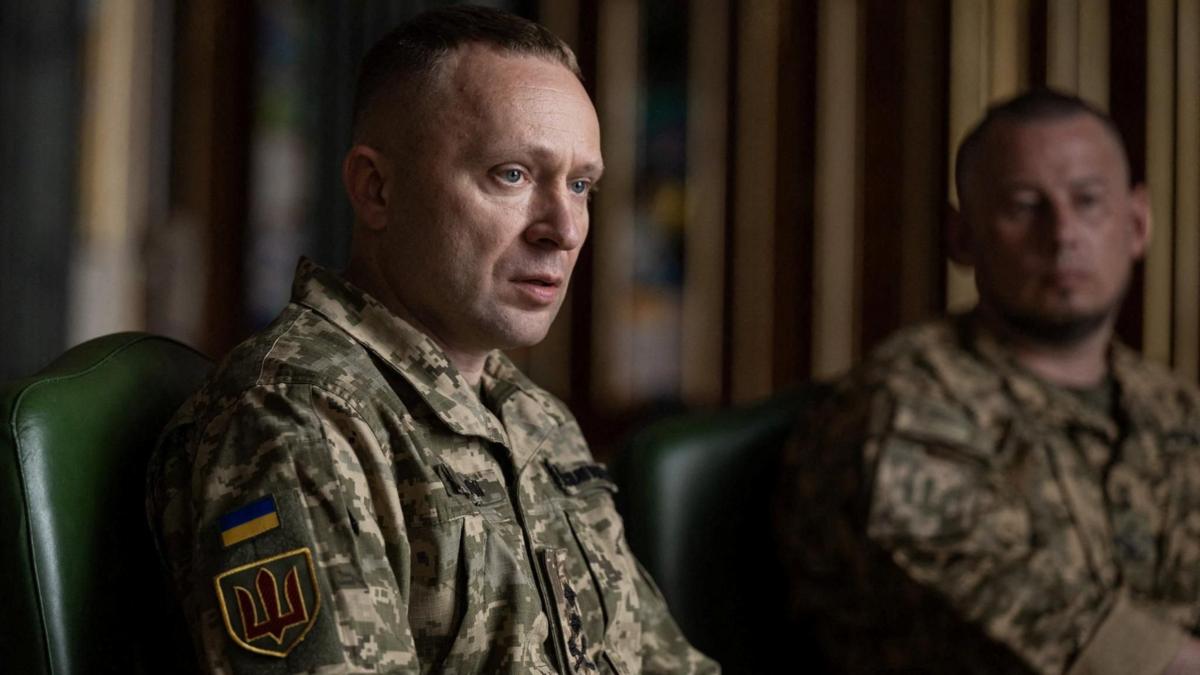
The appointment of Maj Gen Mykhailo Drapatyi as Ukraine's new commander-in-chief marks a pivotal shift in military leadership during a war that has consumed the country for more than two years. Drapatyi, who assumes the role on the back of widespread civilian and military support, is a product of a war that has tested every facet of Ukrainian resilience. His rise is not just a personnel change but a reflection of a force in transition, one that demands both accountability and results.
Unlike his predecessor, Drapatyi is neither an unknown nor a political appointee. His name was chanted during anti-Syrskyi protests, and his presence on the battlefield has long been a matter of public record. A 2004 graduate of the Kharkiv Institute of Tank Troops, Drapatyi's early career unfolded in the shadow of the 2014 conflict, when he led operations that became defining moments in Ukraine's military history.
His rise to prominence was cemented during a May 2014 operation in Mariupol, where footage of his infantry fighting vehicle crashing through a barricade made him a symbol of Ukrainian resolve. The incident also marked a rare instance of direct action under his command, and it was this clarity of purpose — decisive and unflinching — that earned him both a following and respect within the ranks.
A Commander of Conscience and Consequence
Drapatyi’s career has been defined by moments of both military necessity and personal accountability. In 2024, after a Russian missile struck a training ground in the Dnipropetrovsk region, killing 12 soldiers and wounding 60, he immediately resigned, attributing the failure to a 'conspiracy of silence and impunity.' His words, published in a letter, revealed a leader who does not distance himself from the outcomes of war. That moment, more than any, defined him as a rare breed of military leader — one who does not shy from the moral weight of command.
By 2025, Drapatyi had become head of the land forces and was already the subject of whispers about his ambitions. An unnamed officer told Ukrainian media in June 2025 that Drapatyi was 'a relatively young general. He is gifted. He was always sent to places where the situation was extremely difficult.' The same source suggested his ambitions might not be confined to the ground forces, though this remains unconfirmed.
Drapatyi’s elevation to commander-in-chief in early 2026 was not unexpected but was still seen as a bold move. Analysts like Mykola Bielieskov note that Drapatyi’s rise is not just about competence but about trust — a trust earned through field leadership and personal sacrifice. 'The Commander-in-Chief has a lot of leverage,' Bielieskov says, 'but war is a combination of government, the president's office, military suppliers, dependence on [Western] partners. So he's got a tricky path before him.'
Drapatyi’s First Test: Winter, Morale, and Change
Winter has long been a season of both attrition and opportunity in this conflict. With mobilisation a priority and corruption an enduring thorn, Drapatyi will need to balance immediate battlefield demands with long-term reform. Expectations are high for a departure from the 'outdated' tactics of his predecessor, which some critics claim placed too little value on human life in the pursuit of territory.
In his first message, Drapatyi acknowledged the task's difficulty and promised to work 'without making loud promises, with responsibility for our decisions, and with respect' for the front-line troops. This is a contrast to the public theatrics of the past but aligns more closely with the grounded, operational tone he has maintained throughout his career.
Yet Bielieskov warns against 'oversimplification' — a call to remember that while leadership matters, no single person can overhaul a war machine overnight, especially one so deeply entangled with political, economic, and international factors.