
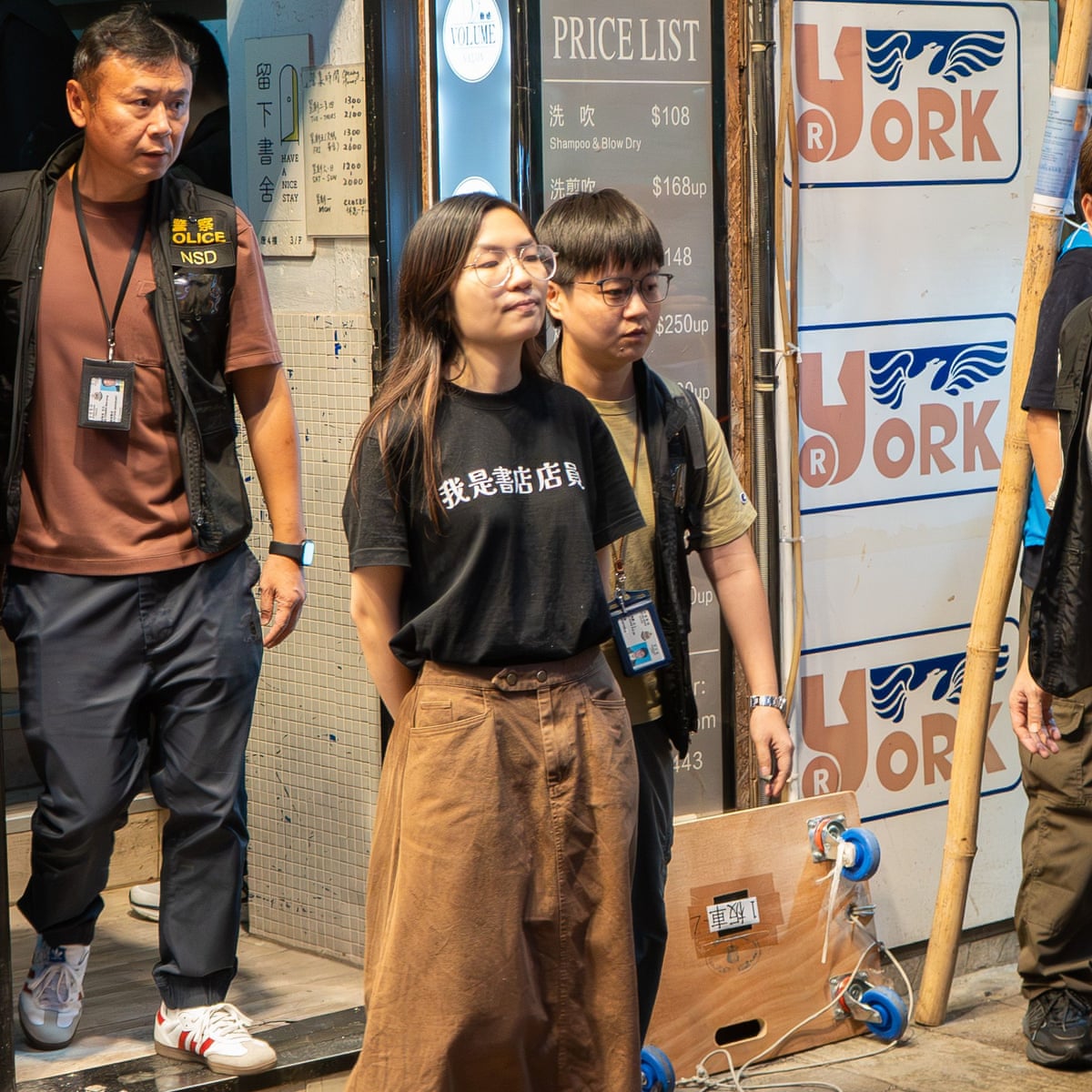
A woman with the words 'I am a bookstore employee' emblazoned on her T-shirt became a symbol of resistance after being arrested during police raids on Hong Kong bookstores. The incident, part of a broader crackdown, has resonated widely in Taiwan, where the hashtag 'I am a bookstore employee' began trending across social media platforms. People from all walks of life, including booksellers, activists, and lawmakers, have used it to show their support for Hong Kong's independent bookstores. Taiwan's president, Lai Ching-te, voiced his backing for free speech, saying on Facebook, 'Ideas and words should never be silenced by political pressure.'
The recent raids mark the third time in months that Hong Kong authorities have targeted booksellers and independent bookstores. While police have not yet disclosed the specific titles they deemed 'seditious,' the arrest has brought attention to Emily Feng's book, Let Only Red Flowers Bloom. The title, which explores Xi Jinping's ideological control in China, became so popular in Taiwan that the publisher, Acropolis Publishing, had to print an emergency additional 10,000 copies.
One customer, Wu Jia-xuan, admitted she wasn't usually drawn to books about China but was intrigued by the Hong Kong raids. The situation has sparked a renewed interest in the book, with independent bookstores like Touat Books in Taipei completely out of stock. Chang Hui-ju, the store owner, noted that before the incident, the book had been largely ignored. 'But right after the incident, the book sold out everywhere,' she said.
Emily Feng's book also tells the story of Lam Wing-kee, a prominent Hong Kong bookseller who was arrested in 2015 by Chinese authorities. After escaping custody, he re-opened his bookstore, Causeway Bay Books, in Taipei. Lam's death earlier this month has left his Taipei store closed and its future uncertain. Supporters have marked the shopfront with notes, flowers, and cans of beer, symbolizing their respect for his legacy. His story reflects the tense dynamics between Hong Kong, Taiwan, and mainland China. Lam's bookstore became a focal point of the ideological struggle that characterizes these regions.
Beijing has long claimed Taiwan as part of its territory, proposing a 'one country, two systems' model as a path to peaceful unification. However, this idea is strongly opposed, with over 80% of Taiwanese rejecting the concept. Politicians in Taiwan, particularly from the ruling Democratic People's Party (DPP), have often referenced Hong Kong's situation to highlight the risks of being under Chinese rule. DPP legislator Wu Pei-yi recently accused China of 'burning books' in response to the bookstore raids. Still, despite vocal support, tangible aid for Hong Kong has been limited.
Lev Nachman, a professor at National Taiwan University in Taipei, noted that while Hong Kong is used as a political symbol to rally opposition to Chinese unification, practical support for Hong Kong refugees is 'shallow.' For Chinese citizens, Taiwan is now the last place in the Chinese-speaking world where they can access books without the threat of Communist Party censorship. This reality is drawing more people, like a student from Fujian province, to seek out books such as Feng's. Visiting Touat Books recently, she searched for a copy to understand the ideological tensions shaping the region.
The bookstore raids and Lam Wing-kee's story highlight the deep connections and conflicts between Hong Kong, Taiwan, and mainland China. As tensions rise, books have become both tools of resistance and symbols of ideological struggle. The spread of slogans and hashtags in Taiwan show how a single event can resonate across borders, sparking global discussions about censorship, freedom of speech, and the future of democracy in the region.