
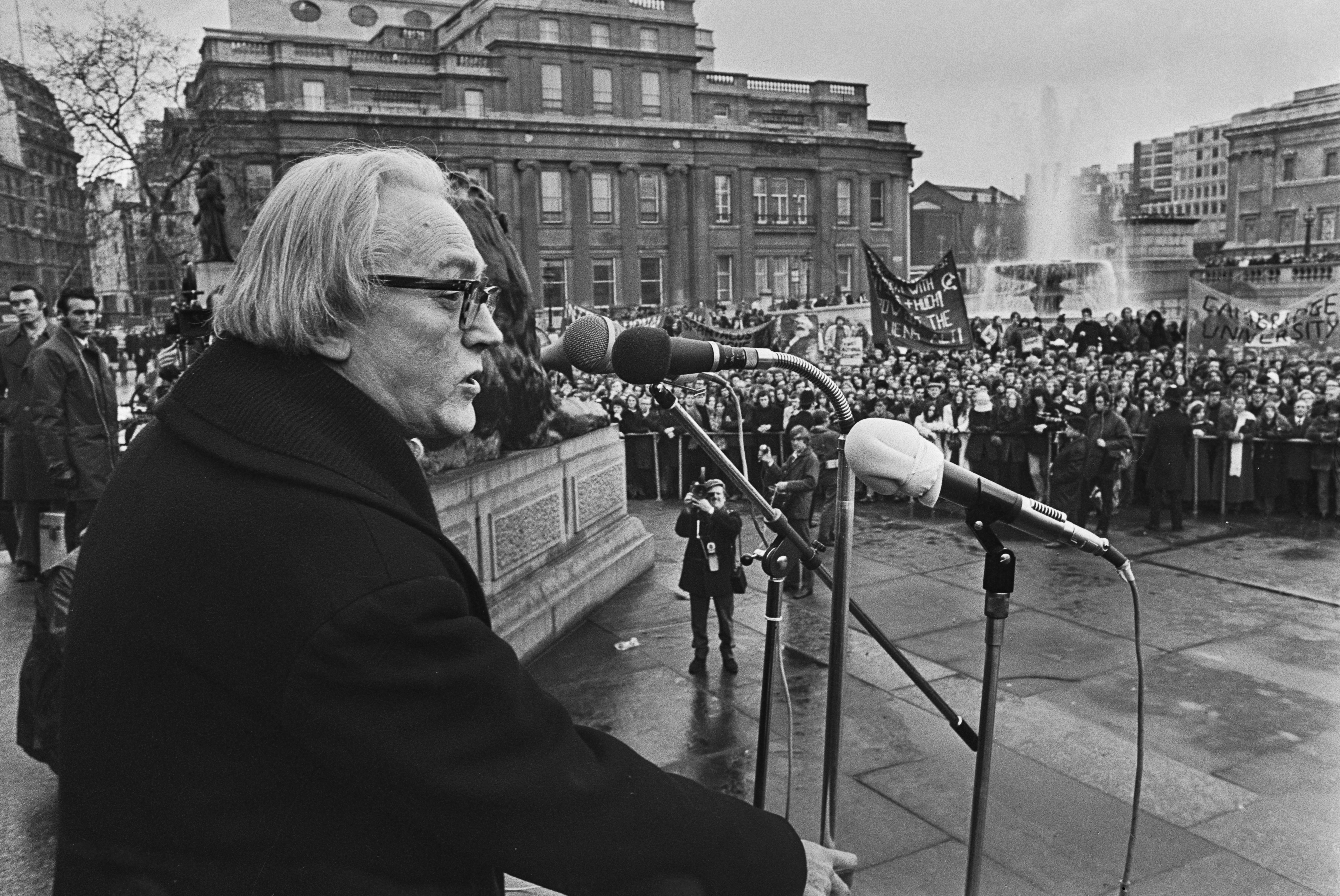
Michael Foot was born on 23 July 1913 in Plymouth to Isaac Foot, a solicitor and political autodidact, and Eva Foot, a politically active mother. The Foot family, already with four children, welcomed Michael into a home where books and politics were central. Isaac, a strict Methodist, shaped a home steeped in public speaking and radical thought. Michael inherited both the love for books and the passion for change. His father, having left school at 14, became a self-taught book collector and a figure steeped in West Country radicalism. These early influences would shape Michael’s lifelong love for books and a deep commitment to political reform.
Foot’s early education took him through local prep schools to Leighton Park, a Quaker institution in Reading. He later attended Wadham College, Oxford, in 1931, studying philosophy, politics, and economics. At Oxford, he found his voice in student politics, becoming president of the Liberal Club and the Oxford Union in 1933. These roles sharpened his public speaking and political instincts. His success in student leadership demonstrated a natural charisma and ability to command attention. The stark poverty he witnessed during the Depression era, with families crowded into damp, unsanitary slums and children suffering from rickets and malnutrition, left a deep impression on him.
From Journalism to Political Firebrand
Foot began his journalistic career in the 1930s at The New Statesman and later at Tribune, a platform set up by Labour MPs including Stafford Cripps and George Strauss. He found a mentor in Aneurin Bevan, another rising Labour star, though their friendship collapsed over disagreements on nuclear disarmament. Tribune was established to promote left-wing politics within Labour, and Foot’s role helped define his early political identity. His time at these publications exposed him to radical left-wing ideas, including admiration for Stalin and support for anti-imperialist movements.
Foot left Tribune in 1938 but had already found his political identity—left of mainstream Labour, anti-imperialist, and a supporter of the India League. By 1935, he had joined the Labour Party and stood for election in Monmouth. Though he lost by nearly 10,000 votes, it marked the start of his political ambitions. This early attempt to enter politics ignited a passion that would define much of his career. Despite the loss, the campaign experience provided him with the skills and confidence to pursue a political career in earnest.
From the Commons to Controversy
Foot won a seat in the 1945 general election in Plymouth Devonport and entered the Commons. He briefly worked for The Daily Herald before returning to Tribune as editor in 1948. His political career gained momentum in 1960 when he returned to Parliament for Ebbw Vale after a by-election. Despite being offered a Cabinet post in 1964, he remained an outsider, critical of Labour’s direction. The 1945 election marked the beginning of a new era in Labour politics. The party’s golden generation, including figures like Hugh Gaitskell, Harold Wilson, and Jim Callaghan, was rising to prominence. Foot, however, remained a firebrand and a gadfly, known for his eloquence and principled stands.
By 1974, Foot was appointed Secretary of State for Employment in Harold Wilson’s government, tasked with managing the volatile trades union landscape. He repealed previous anti-union laws and introduced worker safeguards, gaining some respect from union leaders. Foot's time in government revealed his ability to navigate complex political terrain. His approach to unions involved both appeasement and reform, seeking to balance workers' rights with the broader goals of industrial peace. This role provided a glimpse into the practical challenges of politics, a field where Foot had long operated as a critic rather than a practitioner.
Yet, by 1980, he had become leader of the Labour Party and steered it toward one of its most radical electoral paths. The 1983 Labour manifesto was so far left that it alienated many in the party and the public. Foot's leadership was marked by a clear ideological stance, but it came at a cost. The manifesto’s radical proposals, including nationalization and extensive welfare reforms, were seen by many as unrealistic. A member of the Shadow Cabinet famously described the manifesto as 'the longest suicide note in history,' a label that stuck and reflected the party's deep unpreparedness for a general election.
Foot’s tenure as Labour leader lasted just 2 years and 10 months before he was removed at a special conference. His legacy is a cautionary tale for modern Labour leaders—ambition and ideology can clash when politics is at its most vulnerable. The 1983 election was a disaster for Labour, with the party losing 18 of its 19 seats in Wales and a heavy overall defeat. Foot's time at the helm demonstrated the risks of pursuing an ideological vision without sufficient support from the party or the electorate. His career, marked by passionate speeches and a deep commitment to socialism, remains a point of reference for how not to balance political ambition with practical realities.